
When a Battery Dies — It Usually Isn't Really Dead
Lead-acid batteries have earned a reputation for reliability across more than a century of use — from early automobiles to modern solar installations. Yet they are also notorious for premature failure, and in the vast majority of cases, that failure is neither sudden nor irreversible. It is the consequence of a well-understood chemical process that, given the right intervention, can be reversed.
Understanding why batteries 'die' is the first step to understanding why they can be brought back to life. And it is the scientific foundation on which ReStore Life has built its entire business.
The Chemistry of Failure: Sulphation
A lead-acid battery functions through the electrochemical interaction between lead dioxide (at the positive plate), sponge lead (at the negative plate), and sulphuric acid electrolyte. During discharge, both plates react with the sulphuric acid to form lead sulphate — a soft, soluble compound that naturally reconverts during recharging.
The problem arises when batteries are repeatedly discharged deeply, left in a partially charged state for extended periods, or subjected to temperature extremes. Under these conditions, lead sulphate crystallises on the battery plates — a process called sulphation. Crystalline sulphate does not reconvert during normal charging. It accumulates, progressively blocking the plate surface area, reducing the battery's capacity to hold charge, and ultimately causing what appears to be permanent failure.
The key insight: most 'dead' batteries are not dead — they are sulphated. Sulphation is reversible. This is the premise on which the X Power Regenerator was engineered.
How the X Power Regenerator Works: A Four-Stage Process
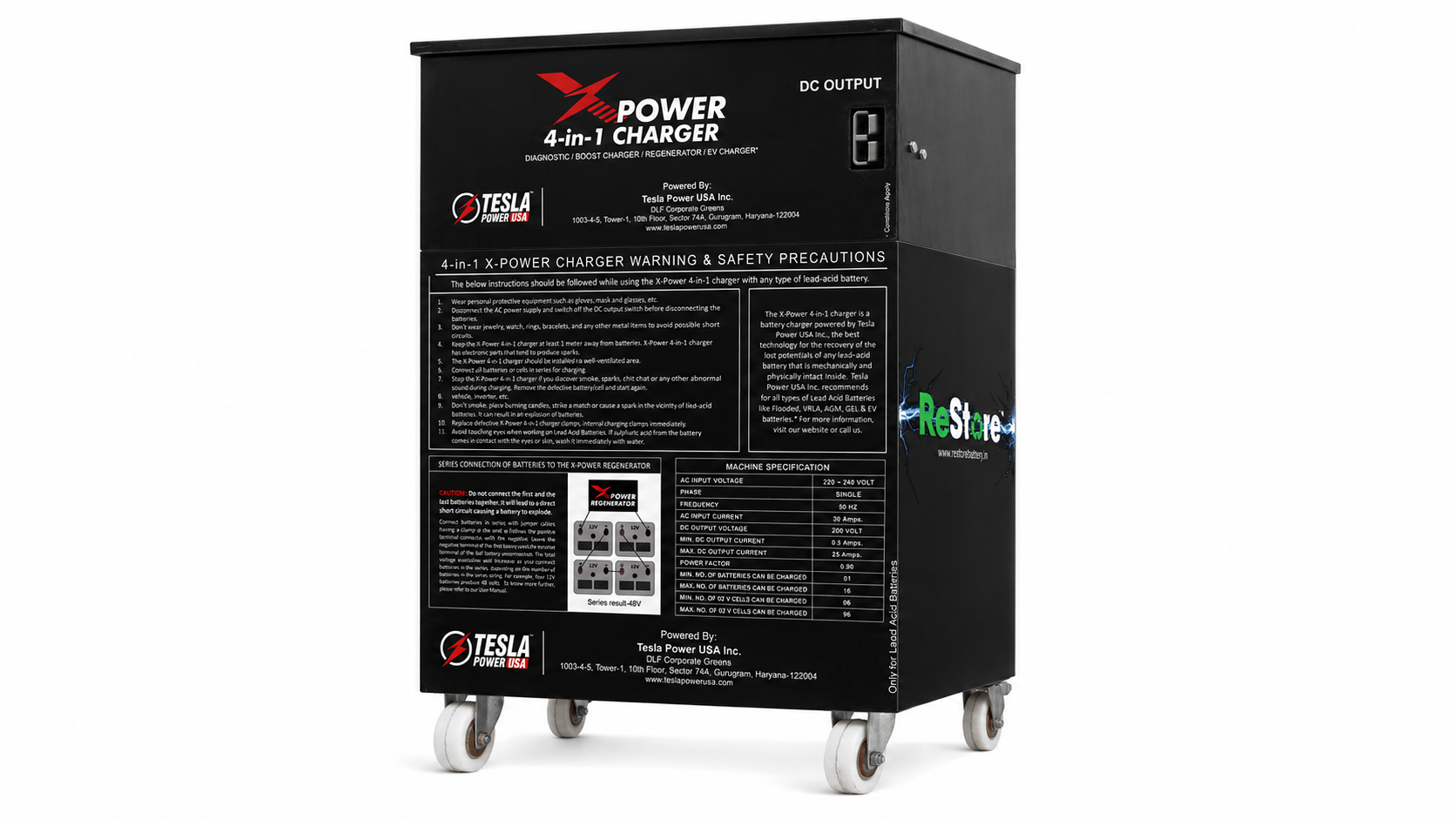
ReStore's flagship technology — the X Power Regenerator (4-in-1) — addresses battery failure through a precise, scientifically structured four-stage process:
- Stage 1: Diagnosis: Before any treatment begins, the X Power Regenerator conducts a thorough diagnostic assessment of the battery's state — measuring open-circuit voltage, internal resistance, and capacity parameters. This data determines whether the battery is a candidate for regeneration or has sustained physical damage beyond restoration.
- Stage 2: Boost Charging: The battery is subjected to a controlled boost charging cycle that brings it to an optimal state for the regeneration process. This stage uses precision-controlled current profiles designed to avoid thermal stress while maximising the battery's receptivity to the subsequent desulphation treatment.
- Stage 3: Regeneration: This is the core of the technology. The regeneration module applies carefully calibrated high-frequency pulse sequences to the battery plates. These pulses break down the crystalline lead sulphate deposits, converting them back into active lead and sulphuric acid. ReStore also employs the Elixir Additive Solution in conjunction — a proprietary additive that enhances electrolyte conductivity, reduces internal resistance, and supports capacity recovery.
- Stage 4: DC EV Charging: The fourth module equips the system for DC electric vehicle charging applications, extending the utility to mobile and emerging energy storage contexts.
Results: What Restoration Actually Delivers
The outcomes of the X Power Regenerator process are measurable and documented across ReStore's three-lakh-battery track record:
- Battery life is extended by a minimum of one to two years post-restoration.
- Capacity recovery of 70–90% of original rated capacity is routinely achieved on batteries with moderate sulphation.
- The process is applicable to both domestic inverter batteries and large-format industrial battery banks.
- The technology has been validated across India and is now being deployed in the Middle East and Africa.
Regeneration technology is not new to electrochemistry — it has been used in niche applications for decades. What ReStore has accomplished is the packaging of this science into a commercially viable, franchisable, scalable service that puts the technology in the hands of trained technicians across India. The result is a battery industry that wastes less, costs less, and contributes measurably to a greener economy.