
The science behind battery rejuvenation: what desulphation actually does.
Most lead-acid batteries do not fail because they are worn out. They fail because of a specific, well-documented chemical process — and one that is partly reversible. Here is what happens inside the battery, and where the honest limits are.
Published 2 August 2026 · ReStore Life · 9 min read
- The short version
- Around 82% of lead-acid failures are linked to sulphate crystal growth on the plates, not wear.
- Lead sulphate forms on every discharge. The problem is when it hardens and grows.
- High-frequency pulses supply enough energy to break the lead–sulphate bond and redissolve the crystals.
- It cannot fix physical damage, and recovery falls sharply on batteries older than about four to five years.
- Independent verification of commercial products is limited — which is why measurement matters more than claims.
What is actually happening inside the battery
A lead-acid battery generates electricity through what chemists call a double sulphate reaction. On discharge, lead and lead dioxide on the plates react with sulphuric acid to form lead sulphate. On charging, that reaction runs backwards and the lead sulphate redissolves into the electrolyte.
Sulphate formation is therefore not a fault. It is how the battery works. The problem arises when the reverse reaction does not complete.
When a battery sits partially discharged for extended periods, small soft sulphate crystals have time to grow into large, stable ones. This is hard sulphation. Research on stationary storage describes it as the primary degradation pathway, with large lead sulphate crystals forming on the negative plates and hindering charge acceptance. Studies find that degradation depends on both the amount of hard sulphate present and the size of the crystal particles.
Those crystals are chemically inert and electrically insulating. They physically cover the active material, so less of the plate is available to react. The measurable consequences are the ones every operator recognises: reduced capacity, shorter backup time, higher internal resistance, poorer charge acceptance.
Published work puts roughly 82% of lead-acid battery failures down to sulphate crystal growth on the plates. That figure is the whole reason rejuvenation is worth doing: the dominant failure mode is chemical, not structural.
Why standby duty is the worst case
Hard sulphation needs one specific condition to develop: time spent at partial state of charge. Which is an exact description of how backup batteries live.
An inverter battery in a home, a UPS bank in a data centre, a telecom tower battery in a low-grid area — none of these are cycled hard. They sit, mostly charged, waiting. Then an outage partially discharges them, and they sit again before fully recharging. Solar storage is similar: charge accumulates through the day, discharges through the evening, and full charge is not always reached.
Research on stationary applications makes the point directly: lead-acid batteries are degraded rapidly by extended periods of high-rate, partial state-of-charge operation — exactly the duty cycle stationary storage demands. The battery is not being abused. It is being used as intended, and the chemistry punishes it for that.
It follows that the batteries most likely to be recoverable are the ones in standby duty, and that the failure is usually premature rather than terminal. A battery designed for around 1,500 cycles commonly gets replaced at roughly 900.
How pulse desulphation breaks the bond
A conventional charger applies steady current. Against hard sulphate that mostly produces heat and gassing, because the crystals will not simply dissolve under ordinary charging voltage — which is the reason a "long slow charge" rarely revives a badly sulphated battery.
Pulse desulphation works differently. Short, high-frequency current pulses deliver enough instantaneous energy to break the molecular bonds between lead and sulphate, allowing the crystals to dissolve back into the electrolyte. Published research describes pulsed current in the kilohertz range achieving exactly this, with the dissolved sulphate returning to the electrolyte and the plate's active surface area becoming available again.
Three parameters do the work, and all three have to be controlled together.
Rise time
How sharply the pulse climbs. A steep edge delivers the energy spike that breaks crystal bonds; a soft one just warms the cell.
Pulse width
How long each pulse lasts. Short enough to avoid sustained heating, long enough to transfer usable energy into the crystal structure.
Frequency
How often pulses repeat. Regulated so existing crystals break down without new sulphation forming in the process.
The reason this works without damaging the battery is that the total energy input stays low. Bonds break because of the sharpness of each pulse rather than the volume of current, so the plates are not subjected to the sustained overcharge that causes grid corrosion and water loss. That distinction matters: research finds peak degradation occurs at charging voltages only slightly above open-circuit potential, around 105% of OCP. Overcharging is itself a degradation pathway, not a cure.
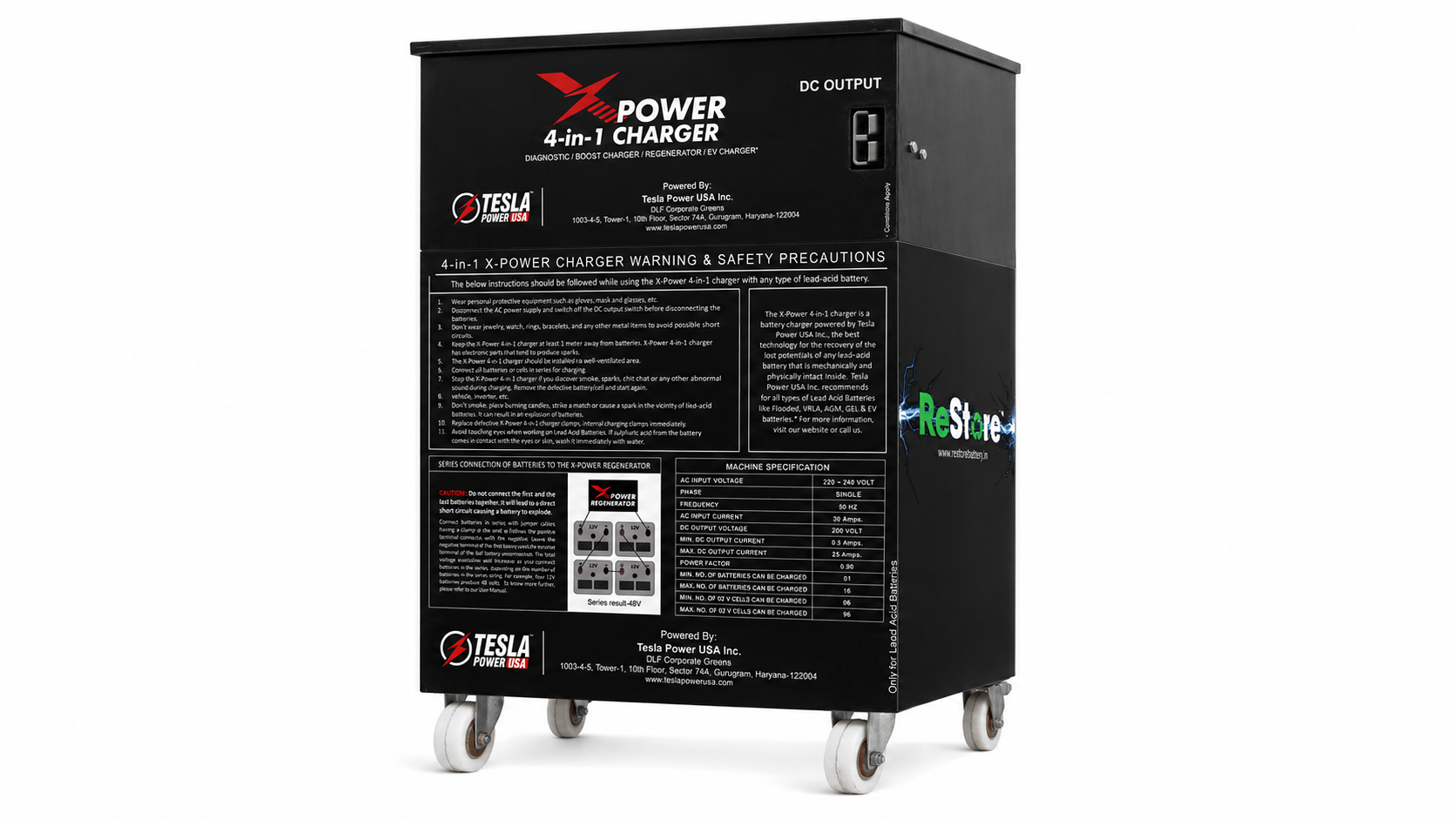
In our own equipment this runs as one stage of a four-part sequence — diagnosis, boost charging, regeneration, then verification — described on the X Power Regenerator page, with the Elixir additive supporting the electrolyte side once surface area is recovered.
The part most vendors leave out
Battery desulphation has a credibility problem, and it is worth addressing directly rather than talking around.
The underlying electrochemistry is well established and appears across peer-reviewed literature. Laboratory studies report measurable capacity recovery after pulse treatment. But independent verification of specific commercial desulphation products is limited, and some technical sources argue that no commercial product has been independently confirmed to reverse sulphation, recommending prevention through regular full charging as the more reliable course.
We think that criticism is largely fair, and it points at the right remedy. The mechanism is real. The variability is real too. Results depend heavily on how old the battery is, how long it has been sulphated and whether anything else has failed. Which means the only honest way to sell rejuvenation is to measure, not to assert.
That is why every battery entering a ReStore service centre is capacity-tested before and after treatment, and why anything failing post-treatment verification is routed to licensed recycling rather than resold. A process that begins with a diagnostic and ends with a measured result does not require anyone to take the chemistry on trust.
What desulphation cannot fix
Rejuvenation addresses one failure mode. It does nothing for the others, and a provider claiming otherwise is worth avoiding.
| Condition | Recoverable? | Why |
|---|---|---|
| Hard sulphation | Usually | Chemical and reversible; the dominant failure mode |
| High internal resistance from sulphation | Often | Falls as active surface area is restored |
| Cracked case or leaking electrolyte | No | Physical damage; a safety hazard, not a chemistry problem |
| Buckled or shed plates | No | Active material has physically left the grid |
| Internal short circuit | No | Structural fault inside the cell |
| Grid corrosion in an old battery | Limited | Positive plate becomes hard to restore after ~4–5 years of service |
Age is the constraint people underestimate. Published work indicates a battery a few months into sulphation can be effectively recharged, with around 80% operational restoration achievable, while the positive plate becomes difficult to restore after roughly four to five years of typical use. Natural degradation accumulates, and no pulse sequence reverses it.
How to avoid needing this at all
Prevention beats recovery, and the preventive measures are neither expensive nor complicated.
- Reach full charge regularly. Partial state of charge is what allows crystals to grow. A periodic full charge is the single most effective preventive step.
- Do not leave batteries discharged. In hot weather sulphation can begin within roughly 24 hours of sitting discharged.
- Keep electrolyte above the plates. Plates exposed to air sulphate immediately.
- Use the correct charge profile. A three-phase cycle — bulk, absorption, float — at an appropriate rate for the battery's rating.
- Monitor rather than wait. Internal resistance rises before capacity visibly falls, so telemetry catches the problem while it is still cheap to fix.
This is most of what a good maintenance contract is actually doing. Scheduled visits, correct charging and continuous monitoring are less interesting than a restoration machine and considerably more valuable over a five-year horizon.
Why the chemistry has commercial consequences
If 82% of failures are chemical and partly reversible, then a large share of battery replacement spending is buying back capacity that was already paid for. At estate scale that is a material number.
The environmental arithmetic runs the same way. Life-cycle assessments of industrial lead-acid batteries find that production energy accounts for roughly 55% of a battery's global warming potential, while the lead itself contributes little because it enters the process almost entirely from recycled stock. Extending service life avoids that production energy. Recycling recovers materials but does not — the full methodology is set out separately.
Both arguments rest on the same physical fact: the plates in most discarded lead-acid batteries are still good. What has failed is a layer of crystal on their surface.
- FAQs
Frequently asked questions.
What causes a lead-acid battery to fail?
Around 82% of lead-acid battery failures are linked to sulphate crystal growth on the plates rather than physical wear. Lead sulphate forms naturally during discharge and normally redissolves on charging. When a battery sits partially discharged for long periods, those crystals harden and grow, blocking the active material and reducing charge acceptance.
What is hard sulphation?
Hard sulphation is the formation of large, stable lead sulphate crystals on the plates — particularly the negative plate. Unlike the soft sulphate produced in normal cycling, these crystals do not redissolve during routine charging. Research indicates degradation depends on both the quantity of hard sulphate and the size of the crystal particles.
How does pulse desulphation work?
High-frequency current pulses supply enough energy to break the molecular bonds between lead and sulphate, allowing the crystals to dissolve back into the electrolyte and restoring active surface area. Published work describes pulsed current in the kilohertz range, with pulse rise time, width and frequency controlled so that existing crystals break down without new sulphation forming.
Does battery desulphation actually work?
The underlying electrochemistry is well documented in peer-reviewed literature, and laboratory studies report measurable capacity recovery after pulse treatment. However, independent verification of specific commercial products is limited, and results vary considerably with battery age and condition. This is precisely why a credible process measures capacity before and after treatment rather than asserting an outcome.
Which batteries cannot be recovered?
Batteries with physical damage — a cracked case, buckled plates, an internal short or heavy corrosion — cannot be recovered by any electrochemical process. Age matters too: research suggests the positive plate becomes difficult to restore after roughly four to five years of typical service, while younger batteries can achieve substantially higher recovery.
How much capacity can rejuvenation recover?
It depends on age and the degree of sulphation. Published work reports recovery approaching 80% of operational capability on batteries treated relatively early, with diminishing returns as natural degradation accumulates. A diagnostic measuring capacity and internal resistance before treatment is what makes the expected outcome knowable rather than hopeful.
Is desulphation safe for the battery?
The process is sealed — nothing is opened and no chemicals are discharged. Pulse energy is applied in short controlled bursts rather than as sustained high current, which is what allows crystal bonds to break without the heat and gassing that damage plates. Overcharging, by contrast, is a known degradation pathway: studies find peak degradation around 105% of open-circuit potential.