
Designing waste out of the energy system.
We treat every battery as a resource. Restoring, reusing and finally recycling keeps lead and other materials in productive loops and lowers demand for virgin extraction — the single largest environmental lever available to a battery business.
1 yr+
Life extension
1M+
Cells in loop
5
Stages in the loop
A closed loop, in five stages.
We operate a closed-loop model: collect, diagnose, restore, redeploy, and — only at true end of life — recycle. Each step is engineered to retain maximum value and minimum waste.
The ordering is the argument. Recycling recovers materials but writes off the manufacturing energy already invested in a battery. Restoration keeps that embodied energy in service for years longer. Recycling is the correct end point — it is not the correct first response.
-
Stage 1
Collect
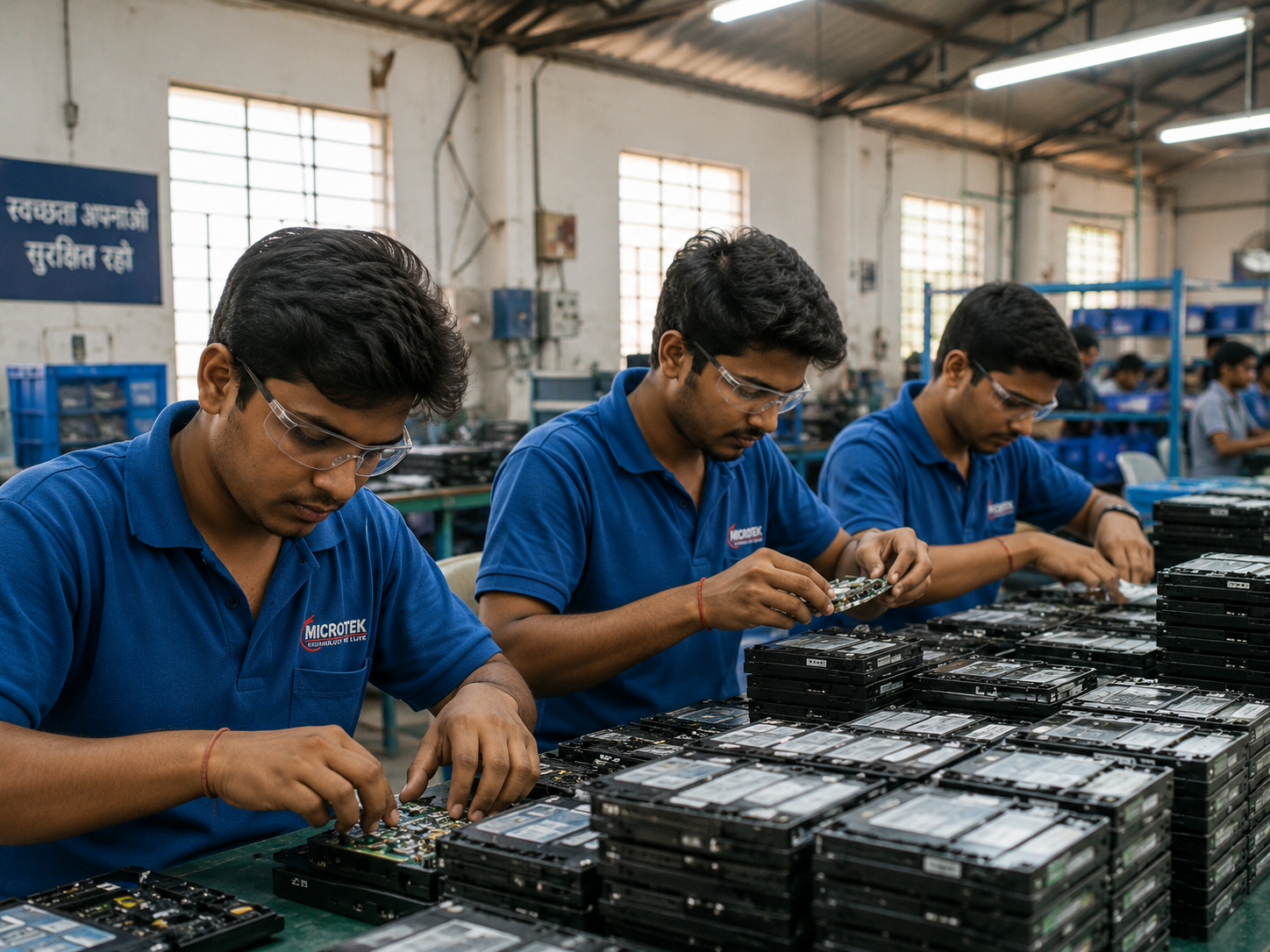
Batteries are gathered through reverse logistics from franchise outlets, AMC sites and enterprise fleets, so units re-enter the loop rather than the informal scrap trade.
-
Stage 2
Diagnose
Capacity, voltage under load and internal resistance are measured to establish state of health. This decides whether a unit is restored, redeployed or recycled — before any work is committed.
-
Stage 3
Restore
Pulse desulphation and controlled reconditioning dissolve the lead sulphate crystals that cause most premature failure, recovering capacity without new manufacturing.
-
Stage 4
Redeploy
Units below commercial thresholds but still holding useful capacity move into stationary storage, micro-grids and community electrification.
-
Stage 5
Recycle
At true end of life, licensed recyclers recover the lead, the polypropylene casing and the sulphuric acid electrolyte, all of which re-enter manufacturing.
Reversing sulphation, not replacing the battery.
Cell-level diagnostics and electrochemical reconditioning extend useful life by up to four times, deferring the carbon and capital cost of new manufacturing.
Most lead-acid batteries do not fail because they are worn out. They fail because hardened lead sulphate crystals accumulate on the plates whenever the battery sits partially discharged, which in practice is most of the time. Pulse desulphation dissolves those crystals and returns the active material to the electrolyte. The X Power Regenerator performs this process across our service network.
Below commercial threshold is not below useful.
Batteries that no longer meet automotive or telecom thresholds find purposeful second lives in stationary storage, micro-grids and community deployments.
A telecom tower needs a battery that can carry a specified load for a specified time, every time. A village school needs lighting after dark. Those are different duty cycles, and a battery that fails the first can serve the second for years. Sixty-two villages have been electrified this way through our CSR programme.
Lead, polypropylene, acid — all recovered.
When a battery finally retires, licensed recyclers separate it into three streams. All three re-enter manufacturing.
| Component | Recovered as | Re-enters |
|---|---|---|
| Plates & terminals | Refined lead | New battery grids and plates |
| Casing | Polypropylene pellets | New battery cases |
| Electrolyte | Sulphuric acid or sodium sulphate | New electrolyte, or textile and glass manufacturing |
Lead-acid is already among the most recycled products in the world, with recovery rates above 95% — largely because the recovered lead has real market value, so the economics work without subsidy. The environmental gain we add is not the recycling itself. It is the years of service we insert before it.
Recycling partners are licensed operators, not informal smelters. Informal lead recovery is a significant source of lead exposure in several of our markets, which is why routing matters as much as rates. See compliance management for the regulatory framework.
Explore the seven pillars.
- FAQs
Circular economy — frequently asked questions.
What is the circular economy in battery storage?
In battery storage, a circular economy means keeping a battery in productive use for as long as possible before recovering its materials. ReStore Life operates a five-stage loop: collect, diagnose, restore, redeploy and — only at true end of life — recycle. Each stage is designed to retain value rather than dispose of it.
How much longer does a restored battery last?
Extends battery life typically by a year or more — and the process can be repeated. Actual recovery depends on the battery's age, chemistry and degree of sulphation. Every unit is capacity-tested before and after treatment, so the outcome is measured rather than assumed.
What happens to a lead-acid battery at end of life?
It goes to a licensed recycler. Lead-acid recycling recovers three components: the lead plates and terminals, the polypropylene casing, and the sulphuric acid electrolyte, which is either neutralised or converted to sodium sulphate. All three re-enter manufacturing. Lead-acid is among the most recycled products in the world, with recovery rates above 95%.
Why restore a battery instead of recycling it immediately?
Recycling recovers materials but discards the manufacturing energy already invested in the battery. Restoration keeps that embodied energy in service for several more years. Recycling is the correct end point, not the first response — which is why our model treats it as stage five rather than stage one.
Which batteries cannot be restored?
Batteries with physical damage — a cracked case, buckled plates, an internal short or heavy corrosion — cannot be recovered and are routed straight to licensed recycling. A diagnostic test identifies these before any restoration work is attempted, so nothing is sold that failed verification.
What is second-life redeployment?
A battery that no longer meets the uptime threshold for a telecom tower or enterprise UPS may still hold well over half its original capacity. Those units are redeployed into stationary storage, micro-grids and community electrification projects where the duty cycle is less demanding.
Put your batteries back in the loop.
Whether you run a fleet, a tower network or a single site, the first step is a diagnostic.